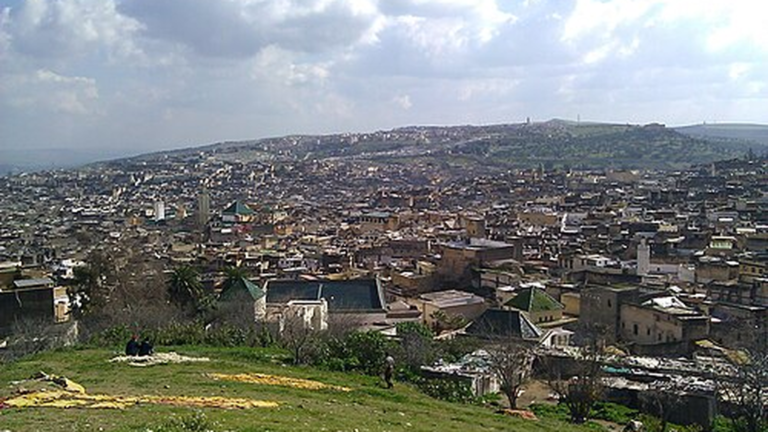
How to Read Fes: Stories, Puzzles, and Clues
Read Fes through its disputed origins: compare traditional accounts of al-Qarawiyyin and al-Andalusiyyin with scholars’ doubts, then trace the Mellah’s uncertain beginnings and the cemetery established there in the 15th century.
The City's Two Faces
A craft trade is still at work in Fes’s medina, with much of the industry relying on tourism. The old city’s workshops and commerce share streets with major religious sites, including the Qarawiyyin complex and the Zawiya of Moulay Idris II. A merchant’s building has changed hands with history: Funduq al-Najjarin was built in the 18th century to house merchants and store their goods; it now contains the Nejjarine Museum of Wooden Arts & Crafts. Across the river of time, the Jewish quarter’s name traveled farther than its walls. It was Morocco’s first quarter called a mellah, and other Moroccan cities later repeated both the name and the urban form. In Fes el-Jdid, the Grand Mosque, built around 1276, had a private passage connecting it directly to the palace for the sultan’s prayers. The Slat al-Fassiyin Synagogue may date to the Marinid period; its possible date gives the Jewish quarter another detail to read.
Every Stone Has a Story (Some Are Even True)
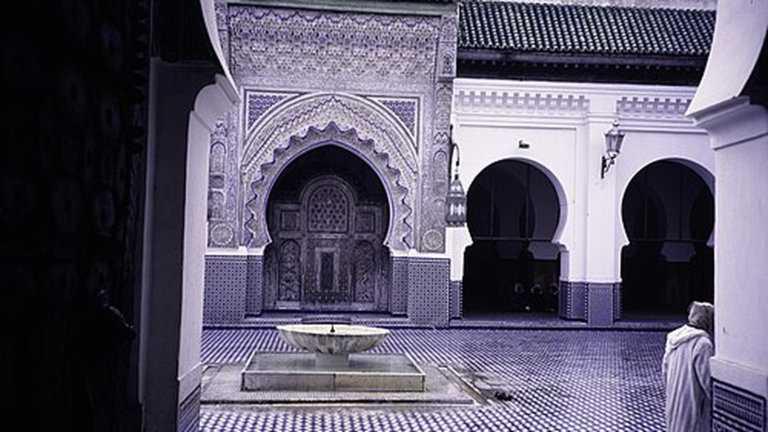
Two sisters, two mosques: Fatima built al-Qarawiyyin, the traditional account says, while Maryam built al-Andalusiyyin. Roger Le Tourneau doubted the paired story, judging its symmetry too perfect and likely a pious legend. Scholar Chafik Benchekroun also argued that Fatima may be legendary rather than historical, and that the inscription associated with al-Qarawiyyin is more likely its original foundation inscription. Jonathan Bloom places the traditional founding story closer to myth than academic history; in his account, no surviving part of the mosque is older than the tenth century.
At Bou Jeloud, a name may point toward soldiers. Historians disagree, but some derive it from Abu al-Junud, “Father of the troops,” connecting it to the nearby parade ground or military square, now also called Place el-Baghdadi. Another origin story sits in New Fez (Fes Jdid): historians disagree about the Jewish quarter’s precise founding date and circumstances, though some place its formation in the Marinid period. Dar Batha brings a palace story into the present: it was completed by Sultan Abdelaziz and converted into a museum of historical art and artifacts in 1915, with around 6,000 pieces. The name, the quarter, the palace: each carries an account with its own degree of certainty.
Famous for a Reason — and Stranger Than You Think
A synagogue near a gate carries a reputation older than its documented date. Slat al-Fassiyin stands just inside the Jewish quarter, close to Bab el-Mellah, and is reputed to be the district’s oldest synagogue; the reputation does not establish a construction date. The palace gates at Place des Alaouites offer another surprise in Fes el-Jdid: their celebrated craftsmanship belongs to gates built in the 1960s and early 1970s. They are an exterior feature of a restricted royal site, so the detail to take in from the perimeter is the metalwork itself. At the northern side of the Old Mechouar, Bab Dekkakin leads into the New Mechouar, turning a gate into a transition between two squares.
The word “medina” covers more ground than Old Fes alone. The Medina of Fez, designated a UNESCO World Heritage Site in 1981, includes both Old Fes and New Fez. In Old Fes, principal souk streets run near major monuments and institutions, while branching lanes can end in residential dead ends; the city’s busiest routes do not promise a through-route at every turn. The Cherratine Madrasa adds a later chapter to the medina’s religious architecture: 'Alawi sultan Al-Rashid commissioned it in 1670, and it is the medina’s largest madrasa. Its scale and date stand apart from the earlier Marinid-era examples. A route through the old city can move from the Jewish quarter’s reputed oldest synagogue to a madrasa commissioned nearly three centuries later, with the streets doing their own editing between stops.
Built in Layers, Argued About in Decades
A closed gate sits beside the monumental entrance, a smaller piece of Fes’s history that cannot take you through. The original gate may date from the 12th century; it remains visible next to the later monumental gate, closed off to passage. At the city’s northern edge, another defensive layer appears in the walls of Old Fes, rebuilt during the Almohad period in the 12th and 13th centuries. The two details belong to different moments: one gate’s date is uncertain, while the northern wall rebuilding is dated to the Almohad era.
In Old Fes, the Saffarin Madrasa gives the Marinid period a specific address and year. Built in 1271, it is identified as the first madrasa of that era. Farther along the city’s dynastic sequence, the Marinid Tombs are 14th-century ruins built as a necropolis for Marinid sultans, near Bab Guissa Cemetery. The madrasa and tombs belong to the same dynasty’s history, but to different centuries and different kinds of buildings: one a religious school, the other a royal burial place.
The walls of Fes el-Jdid carry another military chapter. The Saadians added three bastions to the eastern walls: Borj Sheikh Ahmed, Borj Twil, and Borj Sidi Bou Nafa'. Each name marks a fortification in that eastern stretch. In a later named reign, Sultan Moulay Abdallah, who ruled from 1729 to 1757, built both Moulay Abdallah Mosque and the Alaouite royal necropolis. The mosque and necropolis hold a linked royal history within the quarter; the bastions preserve a separate layer of its defenses. Across Old Fes and Fes el-Jdid, the dates run from a possibly 12th-century gate to buildings raised under an 18th-century sultan.
Beautiful Mistakes
A square in Fes began as a bridge. The Old Mechouar was originally a fortified crossing over the Fes River, at the northern entrance to Fes el-Jdid; its present form stands where a defended passage once carried people across the water. The Marinids built New Fez as a new administrative capital beside Old Fes in the 13th century, and the districts were first linked by a broad walled corridor under Sultan Moulay Hassan. On the west side of the New Mechouar, Dar al-Makina was built under Moulay Hassan as a modern arms factory. Fes keeps changing the job of a place without moving its address: a river crossing becomes a square, and a royal district gains an arms factory. More than a hundred historic funduqs across the old city once housed workshops or lodging for merchants and travelers, and supported commerce including markets and auctions.
Tiny Travel Mysteries
Why did Fes’s Jewish community relocate to the Jewish quarter (Mellah) in Fes el-Jdid, and when?
Historians disagree, but some say the Jewish quarter became Fes’s historic Jewish quarter; scholars debate both the date of its founding and the reasons the community moved there. The uncertainty continues at the quarter’s western edge: some historians associate its Jewish cemetery with land donated by Marinid princess Lalla Mina in the 15th century. Another Fes origin story turns on two sisters. Traditional accounts credit Fatima al-Fihri with founding al-Qarawiyyin in 859 and her sister with founding the Mosque of the Andalusians that year. Some modern historians question Fatima’s historicity, and some regard the sisters’ shared founding story as a pious legend.
Read the City Like a Local
The largest of Fes’s three tanneries is tucked near the Saffarin Madrasa, along the river. Chouara dates to the 11th century and is counted among the world’s oldest tanneries; the medina’s craft history has an address, and it is beside a madrasa. The Royal Palace occupies 195 acres in New Fez and is still used by the King of Morocco. A palace can take up a great deal of a district without opening its doors to you.
The Medina of Fez World Heritage Site has two parts: Fes el Bali and New Fez, listed together in 1981. At the northeastern end of the Jewish Cemetery, a small former synagogue now serves as a small museum. The Al Attarine Madrasa is listed as open from 08:00 to 18:00, with admission at 50 د.م. (≈$5); confirm the current price before visiting. Its listed window gives you a place to continue reading the medina’s religious architecture, after the nearby Saffarin Madrasa and Chouara Tannery.